






















The Pentagon’s newly released National Defense Strategy warns that future wars may no longer be fought solely overseas, arguing the U.S. military must be prepared to conduct combat operations directly from the American homeland as adversaries gain the ability to strike the United States itself.
The strategy, released Friday evening, elevates homeland defense above all other missions, calling for expanded missile defense, counter-drone systems, cyber capabilities and long-range strike forces capable of launching decisive operations from U.S. soil. Pentagon planners describe a global threat environment that is faster, more dangerous and far less forgiving than in past decades.
‘The Joint Force must be ready to deter and, if called upon, to prevail … including the ability to launch decisive operations against targets anywhere — including directly from the U.S. Homeland,’ the strategy states.
‘More direct military threats to the American Homeland have also grown in recent years, including nuclear threats as well as a variety of conventional strike and space, cyber, electromagnetic warfare capabilities,’ it adds.
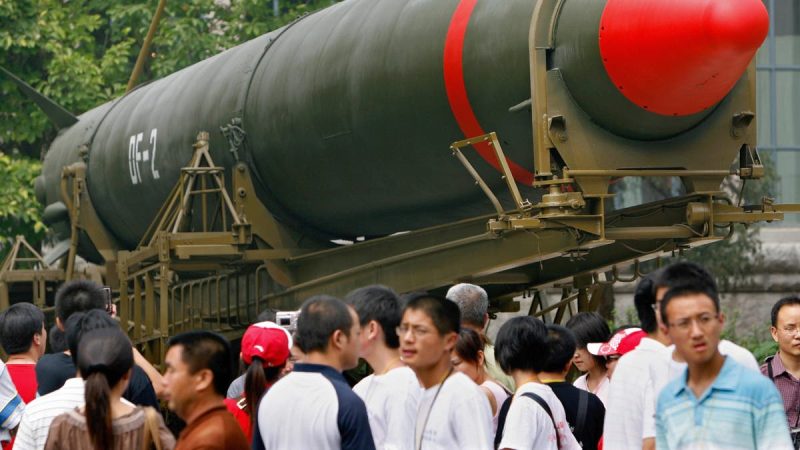
Russia and China both field intercontinental ballistic missiles that can reach the continental United States, while North Korea has tested long-range missiles that U.S. officials say are capable of hitting U.S. territory. Iran is not believed to possess intercontinental ballistic missiles capable of reaching U.S. soil.
As a result, the Pentagon will prioritize President Donald Trump’s planned Golden Dome missile defense shield, with a focus on defeating ‘large missile barrages and other advanced aerial attacks,’ while also hardening military and key civilian infrastructure against cyber strikes.
‘The United States should never — will never — be left vulnerable to nuclear blackmail,’ the strategy says, as it calls for continued modernization of the nation’s nuclear deterrent.
After years of focusing on a potential conflict with China in the Indo-Pacific, the strategy makes clear the Pentagon will seek what it calls a ‘stable peace’ with Beijing, including expanded military-to-military communications.
‘We will also be clear-eyed and realistic about the speed, scale, and quality of China’s historic military buildup,’ the document says. ‘Our goal … is simple: To prevent anyone, including China, from being able to dominate us or our allies.’
Pentagon planners argue deterrence will rely less on confrontation and more on denying China the ability to win a fight outright, particularly in the western Pacific, by blocking attempts to dominate U.S. allies or control key maritime routes.
But China is not the only concern.
The strategy warns the United States could face multiple crises at the same time, with adversaries acting together or exploiting moments of distraction — raising the risk that conflicts overseas could overlap and reach the homeland early.
To manage that risk, the Pentagon is pressing allies to shoulder more of the burden. The strategy calls on European and Indo-Pacific partners to dramatically increase defense spending, freeing U.S. forces to focus on homeland defense and the most dangerous threats.
The document also sharpens the Pentagon’s focus closer to home, treating border security, drug trafficking and access to key terrain as core military missions. It calls for readiness to take decisive action against narco-terrorist groups and to protect strategic locations including the Panama Canal and Greenland.
Distance, the strategy argues, is no longer a shield. Long-range missiles, cyber weapons and drones now allow adversaries to reach the United States directly, compressing warning times and raising the risk that future wars could hit American soil early.
To keep pace, the Pentagon calls for a rapid rebuild of the U.S. defense industrial base, warning that America must be able to produce weapons and equipment at scale if it hopes to deter — or survive — a prolonged fight.
The strategy describes Russia as a serious but declining threat, warning Moscow still poses dangers through its nuclear arsenal and cyber, space and undersea capabilities, even as the Pentagon argues Europe is now capable of taking the lead in its own defense.
‘Russia will remain a persistent but manageable threat to NATO’s eastern members for the foreseeable future,’ the document says, noting Russia continues to modernize ‘the world’s largest nuclear arsenal.’ The strategy makes clear Washington expects NATO allies to shoulder far more responsibility, arguing Europe’s economic and military potential far outpaces Russia’s if allies invest accordingly.
On Iran, the Pentagon paints a picture of a regime weakened by recent U.S. and Israeli military action but still dangerous and unpredictable.
‘Iran’s regime is weaker and more vulnerable than it has been in decades,’ the strategy says, while warning Iran’s leaders ‘have left open the possibility that they will try again to obtain a nuclear weapon.’
The document stresses Tehran’s continued hostility toward the United States and Israel, noting Iran ‘has the blood of Americans on its hands,’ and emphasizes empowering allies, particularly Israel and U.S. partners in the Gulf, to deter Iran and respond decisively if American interests are threatened.
Iran regularly touts its ballistic missile arsenal as a central pillar of its deterrent and retaliatory strategy, showcasing new medium-range and ‘hypersonic’ systems and warning they can strike regional rivals and U.S. interests in the Middle East.
China, meanwhile, has pushed back strongly against the U.S. Golden Dome missile defense initiative, accusing Washington of undermining global strategic stability and risking the weaponization of outer space.