



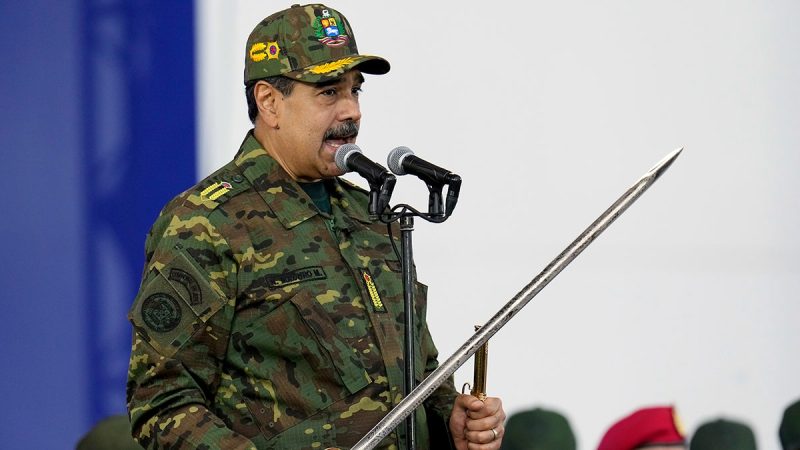
The Trump administration’s latest offensive move against Venezuela, the seizure of a tanker carrying U.S.-sanctioned oil, has triggered predictable outrage from Venezuelan President Nicolás Maduro’s government.
But behind the rhetorical fire, analysts say the regime has few practical ways to hit back without doing even more damage to itself.
Experts say that Maduro could target U.S. oil interests in Venezuela, but doing so would almost certainly inflict more pain on his own cash-starved regime than on the United States.
Maduro could also halt U.S.-chartered deportation flights, but again, would be harming his own interests, experts say.
‘Venezuelans are just leaving the country because of the terrible conditions the regime has created,’ said Connor Pfeiffer, a Western Hemisphere analyst at FDD Action. ‘By having people come back, even if they’re on U.S. charter deportation flights, it kind of counters that narrative.’
Western oil firms have significantly decreased their presence in Venezuela, home to world’s largest proven oil reserves, in recent years due to sanctions.
But U.S.-owned Chevron does still maintain a license to operate there, on the condition that the Maduro regime does not financially benefit from its operations. Instead, Chevron hands over to Maduro half of its oil production as payment, according to multiple reports.
‘Chevron’s operations in Venezuela continue in full compliance with laws and regulations applicable to its business, as well as the sanctions frameworks provided for by the U.S. government,’ a Chevron spokesperson told Fox News Digital.
Imports of Venezuelan crude have declined to roughly 130,000 barrels per day (bpd) to 150,000 bpd in recent months, below the nearly 300,000 bpd seen under the prior petroleum licensing regime under the Biden administration. Most of Venezuela’s exports are now routed to Asia, with the bulk ultimately landing in China through intermediaries, according to data from Kplr.
Despite that flow of crude, analysts say the idea of Caracas striking back at Chevron is more potent as a talking point than as a viable policy option.
Shutting down or seizing the company’s operations would instantly cut off one of the few lifelines still feeding Venezuela’s collapsing oil sector. It also would risk triggering a swift and politically difficult American response, including a full reinstatement of the sanctions relief the regime has quietly relied on.
Pfeiffer noted that the Maduro government has been ‘very supportive of Chevron continuing to operate’ because the arrangement provides tens of thousands of barrels a day of oil with minimal investment from Venezuelan-owned Petróleos de Venezuela, S.A. Other analysts say that reality sharply limits Maduro’s room to maneuver: any attack on Chevron would strike at his own revenue stream first.
Another theoretical lever — military or maritime escalation — is widely viewed as even less credible. Venezuela has taken delivery of small Iranian-built fast attack craft equipped with anti-ship missiles, a fact that has fueled speculation Maduro could threaten U.S. or allied vessels.
But Venezuela’s navy suffers from years of maintenance failures and lacks the ability to sustain operations against American forces deployed in the Caribbean. Any aggressive move at sea would almost certainly invite a U.S. military response the regime is in no position to absorb.
Diplomatically, Caracas could suspend remaining channels with Washington, or file legal challenges in U.S. courts or international forums. Yet previous efforts to contest sanctions-related seizures have gone nowhere, and Venezuela’s relationships in the hemisphere offer limited leverage.
Regional bodies have little sway over U.S. sanctions law, and even supportive governments in Russia, China, or Iran are unlikely to intervene beyond issuing critical statements. Beijing, now the primary destination for Venezuelan crude, has economic interests at stake but few practical avenues to challenge U.S. enforcement actions.
Absent direct military strikes, cracking down on sanctioned oil exports is one of the most potent ways the U.S. can weaken the regime, according to Pfeiffer.
‘This is one of his main sources of revenue keeping the regime afloat.’